Tuesday, August 18, 2026
What is an AI Receptionist in NEMT?


An AI receptionist in NEMT is a voice AI platform that answers every inbound call instantly, 24 hours a day. It books trips, handles “where's my ride?” requests, activates will-call returns, and logs mobility needs automatically, escalating only urgent or complex calls to a human dispatcher.
The Operational Reality: Why NEMT Phone Lines Are Overwhelmed
Every NEMT call centre runs into the same daily pattern. Calls spike between 6 and 9 AM as facilities confirm same-day trips and riders request pickup changes, then spike again in the late afternoon as return trips and will-call activations come in. Layered on top of that predictable rush is a constant stream of “where's my ride?” (WQMR) calls from riders and facility staff checking status, plus late-night trip modifications, cancellations, and next-day scheduling requests that arrive after your dispatch desk has gone home.
Dialysis patients alone generate a disproportionate share of this volume. A single patient on a standing order for three sessions a week produces recurring booking calls, WQMR calls when a session runs long, and will-call activation calls at the end of every appointment. Multiply that across a full dialysis panel, add in skilled nursing facility discharge coordination and same-day urgent requests, and a mid-size NEMT operation can easily field several hundred calls a week that have nothing to do with new business development and everything to do with keeping existing trips running on time.
A missed call in NEMT is not a minor inconvenience. It is a missed trip booking, a frustrated dialysis patient standing outside a clinic, or a facility discharge planner who moves the next contract to a competitor that actually picks up. Long hold times push dispatchers into constant firefighting mode, which drives burnout and turnover in a role that is already difficult to staff. The financial cost compounds quietly: every unanswered call is potential trip revenue that never gets booked, and every overworked dispatcher is a retention risk that costs more to replace than to support properly.
Staffing around these peaks is expensive and imprecise. Hiring enough dispatchers to cover the 6 AM surge means paying for idle capacity at 11 AM, and hiring enough to cover the after-hours will-call window means either paying overtime or leaving the phones unanswered once the day shift clocks out. Most NEMT providers choose the second option by default, not by decision, simply because 24/7 human staffing does not pencil out against the trip volume it would need to justify. That gap between when riders need to reach dispatch and when dispatch is actually staffed is exactly the problem an AI receptionist is built to close.
What is an AI Receptionist in NEMT?
An AI receptionist in NEMT is a specialised voice AI platform built specifically to handle inbound and outbound calls for medical transportation operations, using natural language processing (NLP) to understand what a caller actually needs rather than forcing them through a rigid menu tree.
This is a meaningful difference from the generic IVR systems many NEMT providers already have. A traditional “press 1 for scheduling, press 2 for status” system frustrates elderly riders and patients with mobility or cognitive limitations, who often just want to say “I need to know when my ride is coming” and be understood immediately. An IVR cannot handle a rider who mumbles, speaks with a strong accent, or provides information out of order. A well-built AI receptionist listens to natural speech, extracts the trip details or request from conversational language, and responds the way a well-trained human dispatcher would, without the caller ever navigating a menu.
Consider a typical call: a rider finishing a dialysis session says, “Hi, I'm done here at the clinic on Main Street, can you send my ride back?” A menu-based IVR has no path for that sentence. An AI receptionist recognises it as a will-call activation, matches the caller to their standing order, confirms the pickup location, and dispatches the return trip, all inside a single natural exchange. The same system handles a facility coordinator calling to say “we need to move Mrs. Rodriguez's 2 PM appointment to 3:30 tomorrow” just as fluently, updating the manifest without a dispatcher touching the request.
Key Capabilities of an AI Receptionist in NEMT
24/7 Instant Call Answering: Every call is answered on the first ring, including after-hours, weekends, and holiday surges, eliminating the missed-call gap that costs providers trip revenue.
Automated Trip Booking and Modifications: Routine scheduling, cancellations, and reschedules are handled start to finish without a dispatcher touching the call.
Real-Time “Where's My Ride?” (WQMR) and Live ETA Updates: Callers get live status directly from the AI, removing the back-and-forth between dispatcher and driver that a WQMR call normally triggers.
Will-Call Voice Activation: Riders finishing a medical appointment can activate their return pickup by voice, instantly, without waiting on hold to reach a human.
Medical and Mobility Preference Capture: Special requirements, wheelchair needs, oxygen equipment, stretcher transport, door-to-door assistance, are captured and logged automatically on the trip record.
Traditional Dispatcher vs. AI Receptionist in NEMT
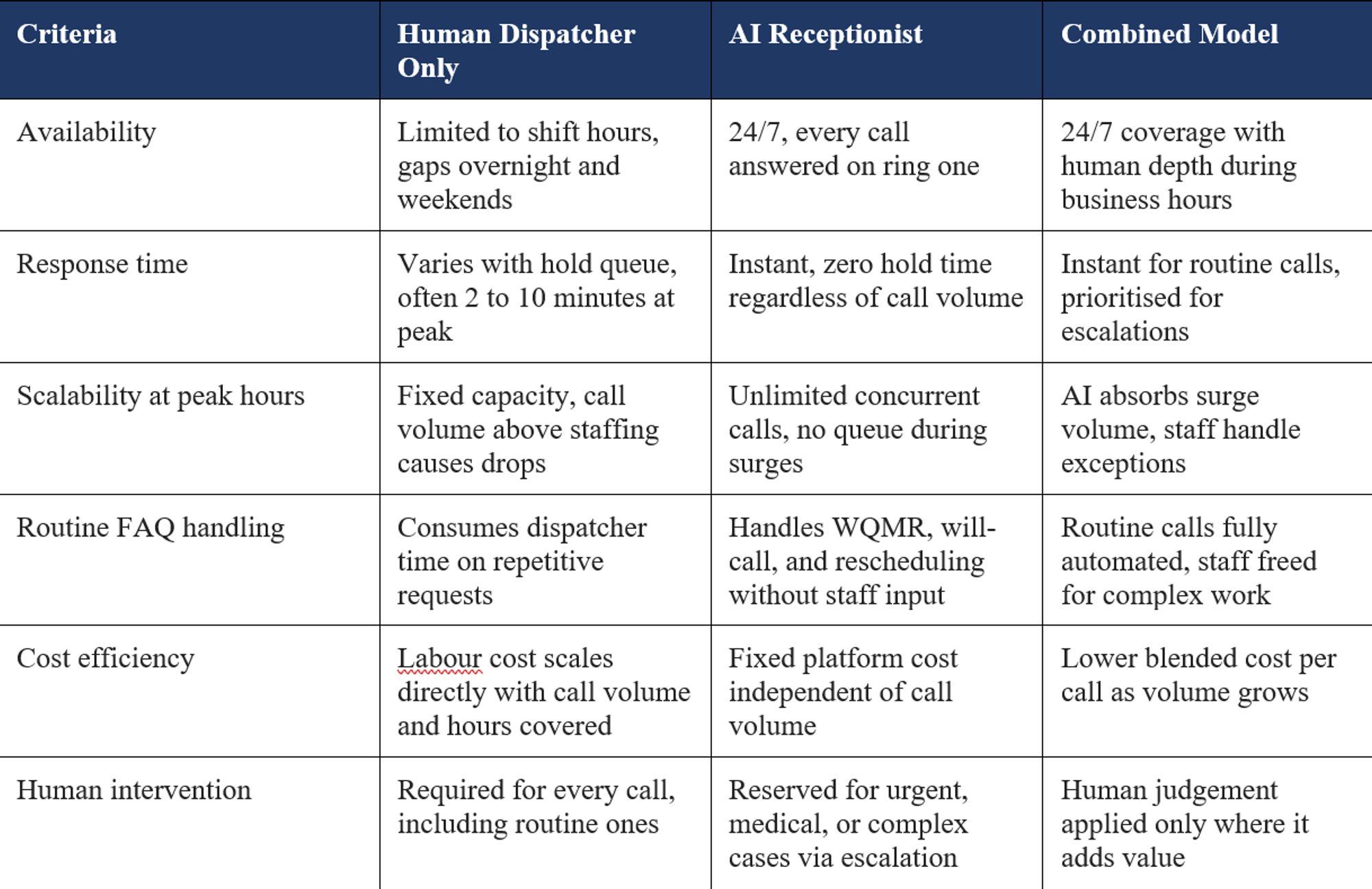
The comparison is not an argument for eliminating dispatchers. It is an argument for putting each type of call in front of the resource best equipped to handle it. Routine, repetitive, and time-sensitive calls, booking, status checks, will-call, are exactly the category where an AI receptionist outperforms a human on speed, availability, and consistency. Calls involving genuine judgement, an unusual medical situation, a difficult facility negotiation, a distressed caller, are exactly the category where a human dispatcher's experience and empathy cannot be replaced. The combined model in the right-hand column is where most operators land in practice: AI absorbs the volume, humans apply the judgement.
How an AI Receptionist Integrates into Your Daily NEMT Workflow
Step 1: Inbound Call Handling
Every call is answered on ring one, whether it arrives at 7 AM during the morning rush or 11 PM from a rider whose appointment ran late.
Step 2: Intent Recognition and Data Verification
The AI identifies the caller, pulls up their trip details or standing order, and determines whether the call is a booking request, a status check, a modification, or an escalation.
Step 3: Real-Time Action and Logging
The AI books the trip, updates the dispatch manifest, activates will-call, or records the caller's notes directly into your dispatch system in real time, with no manual re-entry required.
Step 4: Governed Human Escalation
Calls involving a medical emergency, an unusually complex itinerary, or a distressed caller are instantly transferred to a human dispatcher, with full context already logged so nothing has to be repeated.
Key Business Benefits for NEMT Providers
Reduced operational and staffing costs, since routine calls no longer require a dedicated dispatcher on every shift, and after-hours coverage no longer requires overtime pay or an answering service.
Higher patient and care facility satisfaction, driven by zero hold times and consistent, accurate call handling that does not degrade during peak call volume.
Zero missed revenue from unanswered ride requests, since every call is picked up regardless of volume or time of day, converting calls that would otherwise go to voicemail into booked trips.
Burnout protection for human dispatchers, who are freed to focus on complex trips, exceptions, and relationship management instead of absorbing the full weight of repetitive call volume.
These benefits compound over time rather than appearing as a one-time efficiency gain. As trip volume grows, an operation staffed entirely by human dispatchers needs proportionally more headcount to keep hold times manageable. An operation running a capable AI receptionist absorbs that same growth in call volume without a corresponding increase in staffing cost, which changes the unit economics of scaling a facility contract or adding a new service area.
Frequently Asked Questions
Does an AI receptionist replace human NEMT dispatchers?
No. A well-designed AI receptionist is built to absorb routine call volume, booking, status checks, and will-call activation, so human dispatchers can focus on complex trips, facility relationships, and exceptions that genuinely need judgement. Urgent and medically sensitive calls are escalated to a human by design, not handled by the AI alone.
How does the AI handle non-English speaking callers or complex instructions?
A capable NEMT voice AI supports multiple languages and is built to parse conversational, non-linear speech, including callers who provide information out of order or use informal phrasing. When a request is too complex or ambiguous for confident automated handling, the call is routed to a human dispatcher rather than guessed at.
What happens if a caller has an urgent emergency?
An AI receptionist should be designed to recognise emergency language and distress signals in a call and immediately escalate to a human dispatcher or the appropriate emergency protocol. It handles non-emergency scheduling and status calls; it should never attempt to manage a medical emergency independently.
Can an AI receptionist integrate with existing NEMT dispatch software?
Yes, when built correctly. An AI receptionist should connect directly with existing dispatch and scheduling systems, so trip bookings, cancellations, and status updates made through it appear directly on your dispatch manifest without manual re-entry or a separate system to check.
NEMTalk: What This Looks Like in Practice
NEMTalk is an example of this technology built specifically for NEMT operations. In practice, it changes the shape of a dispatcher's day rather than just the call volume on a report. Operators running NEMTalk see their morning rush and after-hours will-call window handled without anyone standing by the phone, since NEMTalk answers on the first ring at 6 AM and at midnight the same way. Facility coordinators calling to move an appointment get an immediate, accurate update to the manifest instead of a callback promise, which is often the difference between keeping a contract renewal conversation smooth and fielding a complaint about responsiveness.
The operational effect compounds during the periods that matter most: a dialysis clinic's Monday morning surge, a snowstorm that triggers a wave of same-day reschedules, or a holiday weekend when the office is closed but ride requests are not. NEMTalk keeps answering through all of it, at the same speed, without the fatigue or inconsistency that creeps into human call handling under sustained pressure. Dispatchers come back to a shift with a clean, accurately logged queue of exceptions to handle, rather than a backlog of voicemails to work through first.
Conclusion: The Future of NEMT Call Automation
NEMT operators are not overwhelmed because their teams are underperforming. They are overwhelmed because phone volume in this industry is structurally higher than most dispatch teams can staff for, especially at the morning rush, the will-call window, and every hour after the office closes. A 24/7 AI receptionist does not just answer more calls. It removes the ceiling on how many calls your operation can handle without adding headcount, protects the dispatchers you already have from burnout, and captures trip revenue that would otherwise be lost to a missed call.
NEMTalk runs as an independent system, built to connect with the dispatching, routing, and billing tools you already use, whatever platform that happens to be. If you want to hear what this sounds like on a real call, schedule a live demo at www.nemtalk.com/contact.