Tuesday, August 25, 2026
Is Using an AI Receptionist Compliant With HIPAA in NEMT? The Complete Guide

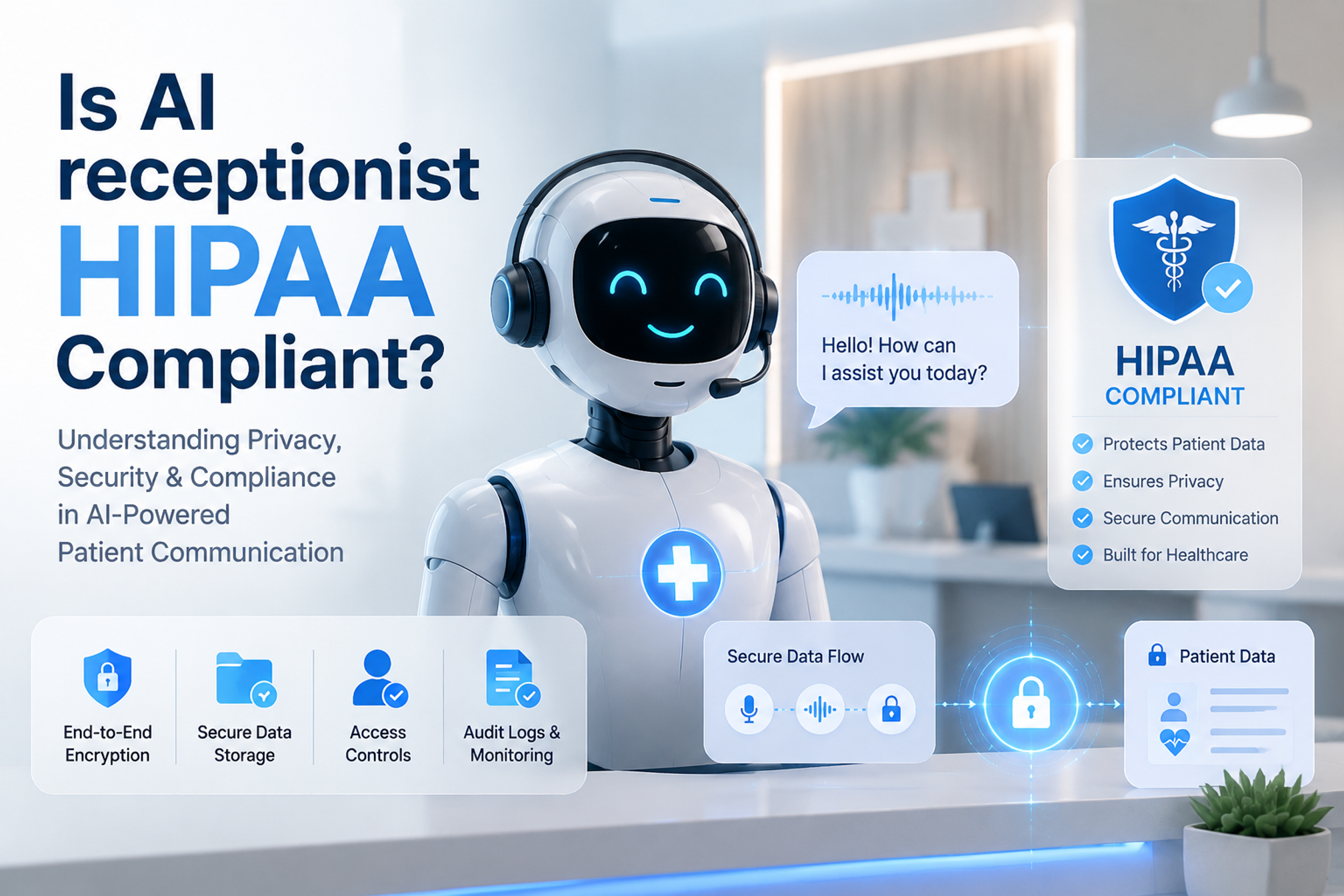
An AI receptionist is HIPAA compliant when deployed within a secure infrastructure that signs a Business Associate Agreement (BAA), enforces strong encryption (TLS 1.3 in transit, AES-256 at rest), applies strict role-based access controls, maintains detailed audit logs, and follows the “minimum necessary” standard for electronic Protected Health Information (ePHI).
Why HIPAA Compliance Matters for Inbound NEMT Calls
A routine NEMT booking call captures more electronic Protected Health Information (ePHI) than most providers stop to consider. A single call can include a patient's full name, the specific medical facility for pickup or drop-off (which itself can reveal a diagnosis category, an oncology center or a dialysis clinic, for example), specialized mobility needs like wheelchair or stretcher transport, and a Medicaid ID number. Under HIPAA, this data is protected the same way it would be inside a hospital's own systems, regardless of the fact that it was captured over a phone call rather than through a clinical portal.
The risk of getting this wrong is not abstract. HHS Office for Civil Rights (OCR) enforces HIPAA violations under a four-tier civil penalty structure, with per-violation fines and annual caps that scale with the entity's level of culpability, and the statutory maximum reaches into the millions of dollars for the most severe, uncorrected violations. Beyond the direct financial penalty, a documented compliance failure typically means reputational damage that is difficult to reverse and the loss of broker or facility contracts, since Managed Care Organizations and healthcare facilities increasingly audit their transportation vendors' data handling practices before renewing an agreement.
The Core Technical and Legal Pillars of a HIPAA-Compliant AI Receptionist
Pillar 1: Signed Business Associate Agreements (BAAs)
A BAA must cover every stage of the voice pipeline, not just the initial call. That means voice processing, transcription, and storage all need to be within the scope of the signed agreement, since a gap in coverage at any one stage leaves ePHI outside the contractual protection HIPAA requires.
Pillar 2: Data Encryption
HIPAA itself is technology-neutral and does not mandate a specific encryption algorithm by name, but it does require encryption strong enough to render ePHI unusable if intercepted. TLS 1.3 in transit and AES-256 at rest are the current industry-standard implementations that satisfy this requirement for both call audio and transcripts.
Pillar 3: Zero-Model-Training Policies
Patient voice data and call transcripts should never be used to train third-party public AI models. Without an explicit zero-training policy, a vendor could technically be compliant on encryption and access control while still allowing sensitive call content to influence a model used outside the provider's own environment, which defeats the purpose of the other safeguards.
Pillar 4: Role-Based Access Control and Audit Logging
Access to call recordings and transcripts should be restricted by role, so only staff with a legitimate operational need can retrieve a given call. Every access event, along with every call itself, needs an immutable, timestamped log, so a provider can demonstrate exactly who accessed what and when if that record is ever requested during an audit.
Pillar 5: The “Minimum Necessary” Rule
The AI should capture only the specific details required to dispatch the trip safely and accurately, not incidental medical detail beyond that scope. A caller mentioning an unrelated health condition in passing should not become part of a permanently stored trip record if it has no bearing on the transport itself.
Standard Answering Services vs. HIPAA-Compliant Voice AI
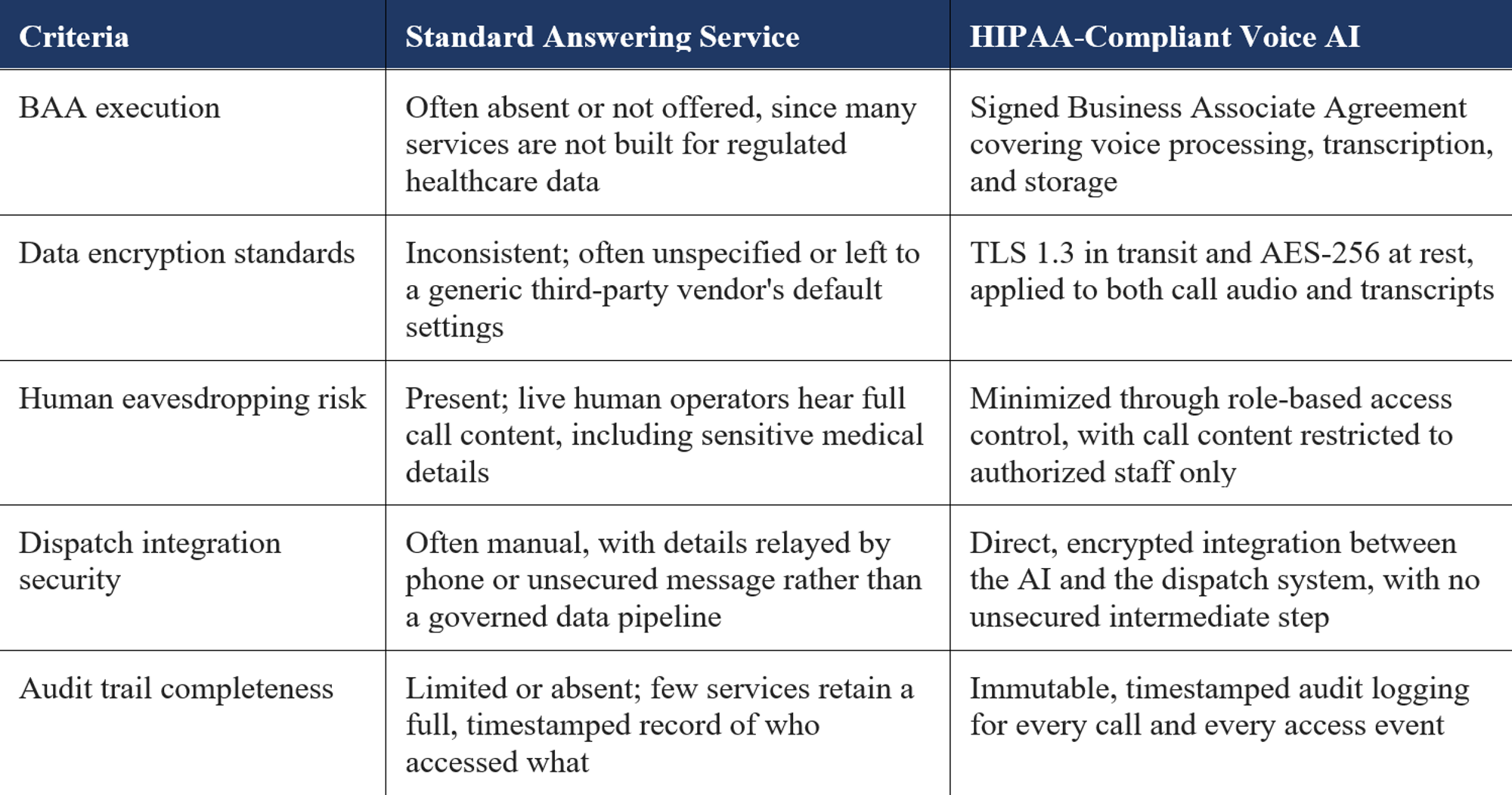
The comparison matters because many NEMT providers currently rely on a generic third-party answering service for after-hours coverage, without having verified whether that service is actually equipped to handle ePHI under HIPAA at all. A service built for general business call answering, restaurants, retail, home services, was never designed around healthcare data handling requirements, and retrofitting compliance onto that kind of platform is rarely straightforward.
How Voice AI Safely Handles Edge Cases
A “where's my ride?” (WQMR) status check is one of the most common calls an NEMT line receives, and it is also a point where ePHI can leak if handled carelessly. A properly built voice AI verifies the caller's identity, matching name, phone number, or a trip-specific detail against the record on file, before disclosing any trip status or location information, rather than assuming that anyone who calls in is entitled to that data.
Complex cases, a caller providing detailed medical notes, or someone claiming to be an authorized representative calling on a patient's behalf, are handed off securely to a human dispatcher rather than resolved by the AI alone. The handoff includes the verified context already gathered, so the human dispatcher can confirm authorization and proceed without asking the caller to repeat sensitive information from the beginning.
Frequently Asked Questions
Does HIPAA certify AI receptionist software providers?
No. HHS and the HIPAA regulations do not issue an official certification or seal of approval for any software vendor. Compliance is demonstrated through documented technical safeguards, a signed BAA, and the vendor's ability to withstand an audit, not through a certificate a company can display.
Are AI-generated call transcripts and recordings classified as ePHI?
Yes, when the call involves a patient's health information, transportation needs tied to a medical condition, or any other identifiable health-related detail. Transcripts and recordings carry the same protections as the original call and must be encrypted, access-controlled, and logged accordingly.
Can an AI receptionist verify a patient's identity before sharing ride status?
Yes. A properly built system verifies identity using details already on file, name, phone number, or trip-specific information, before disclosing any status or location data, which prevents an unverified caller from obtaining another patient's information.
Is a BAA required between the NEMT provider and the voice AI vendor?
Yes. Any vendor that creates, receives, maintains, or transmits ePHI on behalf of the NEMT provider is a business associate under HIPAA, and a signed BAA is a legal requirement before that vendor can handle patient call data, not an optional best practice.
How does NEMTalk ensure complete HIPAA compliance for NEMT fleets?
NEMTalk is built on a healthcare-first architecture and signs a Business Associate Agreement with every NEMT provider it serves. It applies end-to-end encryption to call audio and transcripts, enforces strict role-based governance over who can access ePHI, and integrates directly and securely with dispatch systems, giving providers a documented, audit-ready compliance posture without building that infrastructure themselves.
Who This Guide Is Specifically For
This guide is for NEMT business owners vetting voice AI technology who need to know what compliance actually requires before signing a vendor contract. It is for healthcare transportation compliance officers responsible for documenting that automated patient communications meet federal privacy standards. It is for medical facility managers seeking assurance that a transportation partner's call handling will not become a liability exposure for their own organization. If patient call data touches your operation in any form, this guide is written for the decision you are about to make.