Wednesday, September 2, 2026
How to Reduce Missed Calls in NEMT (And Never Lose a Ride Again)

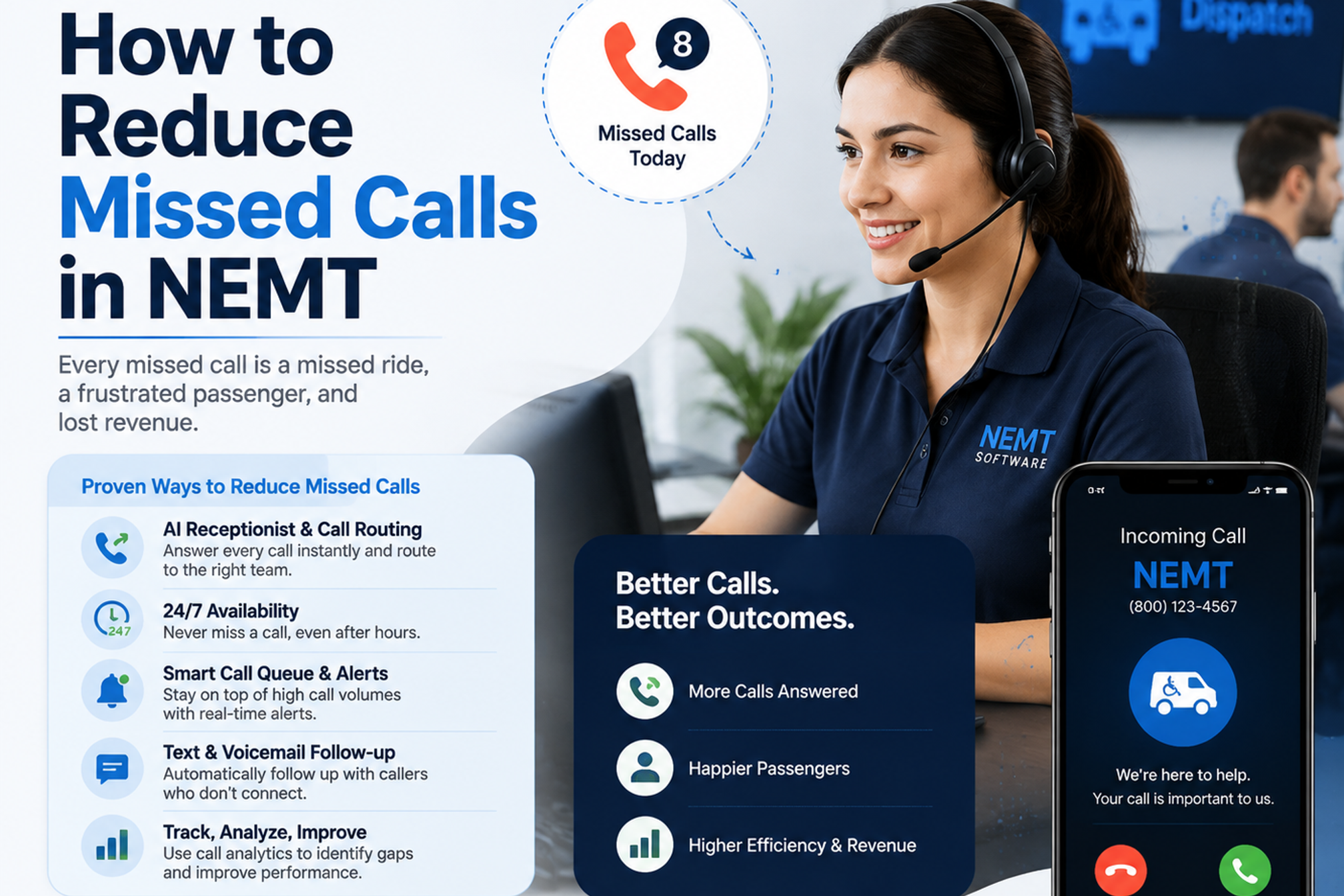
Every missed call in a non-emergency medical transportation business is a missed ride. And every missed ride is lost revenue, a frustrated patient, and a facility that starts looking for another provider.
The problem is not that NEMT operators don't care — it's that the current call handling model is structurally broken. One dispatcher. Multiple lines. Peak hours, after-hours gaps, lunch breaks, and high call volumes that no human team can absorb without dropping calls. The math doesn't work.
This guide breaks down the core reasons NEMT providers miss calls, what the real cost looks like, and the most effective strategies to fix it — including why more operators are switching to AI receptionists to solve this permanently.
Why NEMT Providers Miss So Many Calls
Before fixing the problem, you need to understand where calls are actually falling through.
After-hours volume. A significant portion of ride requests come in outside business hours — patients scheduling next-day trips, caregivers coordinating morning pickups, facilities booking recurring transport. If your phones go to voicemail after 5 PM, you're losing those bookings to a competitor who picks up.
Dispatcher overload during peak hours. Morning scheduling windows and afternoon confirmations create call spikes that a single dispatcher cannot handle alone. When two calls come in simultaneously, one goes unanswered — or the caller waits on hold long enough to hang up.
No call redundancy. Most small and mid-size NEMT operations have no backup system. If the dispatcher is on another call, handling paperwork, or simply unavailable, the phone rings out. There's no queue, no overflow, no fallback.
High turnover creating coverage gaps. NEMT dispatch is a high-stress, low-margin role. When a dispatcher leaves or calls out sick, call handling collapses. There's rarely a trained backup ready to step in immediately.
The Real Cost of a Missed Call in NEMT
Most operators underestimate this. A missed call is not just one lost trip.
If a patient calls to book a recurring weekly ride and you miss that call, you're not losing $30 — you're losing $30 multiplied by 52 weeks, plus the referral that patient might have generated from their care facility. A single missed call from a healthcare facility that sends you 10 rides a month costs you far more than the immediate trip.
Beyond revenue, missed calls damage your reputation with hospitals, dialysis centers, and rehab facilities. These facilities track which providers respond reliably. Unreliable call handling gets you quietly removed from their preferred vendor list — and you rarely know why.
5 Strategies to Reduce Missed Calls in Your NEMT Operation
1. Extend Your Call Coverage Hours
The lowest-effort fix: route after-hours calls to a dedicated line or service instead of letting them go to voicemail. Even a simple answering service that captures the caller's information and trip details reduces drop-off significantly. The goal is zero unanswered calls, regardless of time.
2. Implement Call Queuing
If your phone system doesn't have a queue, callers who hit a busy line just hang up. A basic IVR queue — even with a hold message and estimated wait time — retains a meaningful percentage of callers who would otherwise bounce. This is a phone system configuration change, not an operational overhaul.
3. Hire a Dedicated Intake Coordinator
If your dispatcher is handling both inbound calls and active dispatch simultaneously, the role is split in a way that guarantees dropped calls. Separating intake from dispatch — even part-time during peak hours — reduces missed calls without requiring a full technology overhaul. The tradeoff is cost and the same coverage gap problem after hours.
4. Use a NEMT-Specific Scheduling App With a Client Portal
Some NEMT software platforms offer client-facing portals where patients or facilities can book, modify, or cancel trips without calling at all. This deflects call volume by moving routine transactions online. The limitation: not all patients (especially elderly or non-tech-savvy riders) will use a portal, and facilities often prefer calling.
5. Deploy an AI Receptionist Built for NEMT
This is the most scalable fix, and it's the one that directly solves the structural problem — unlimited call capacity, zero after-hours gaps, no sick days, no training lag.
An AI receptionist for NEMT providers handles inbound calls exactly like a human dispatcher would: it greets the caller, collects trip details, books or modifies rides, provides ETA updates, and answers common questions — all in real time, 24/7. The calls are handled instantly with no hold time, no queue, and no missed connections.
The difference from a generic answering service is specificity. A NEMT AI receptionist understands the terminology, the workflow, and the types of requests your callers make — will-call activations, round trips, mobility accommodations, facility pickups. It's not a generic IVR tree. It's a voice agent that can carry a full conversation and complete a booking.
NEMTalk is built specifically for this use case. It integrates with your dispatch workflow, logs all call interactions, and runs around the clock — so your operation stays responsive whether it's 2 PM or 2 AM.
What to Look for in an AI Receptionist for NEMT
Not all voice AI tools are built for healthcare transportation. When evaluating options, confirm the following:
HIPAA compliance. Any tool handling patient trip information must meet HIPAA requirements — that means a Business Associate Agreement (BAA), data encryption at rest and in transit, and secure call logging. Do not deploy a voice AI that cannot produce a BAA.
NEMT-specific workflow understanding. Generic AI receptionists are trained on broad use cases. A NEMT AI needs to handle will-call trips, mobility accommodation notes, facility-specific pickup protocols, and round-trip confirmations. Confirm the tool understands your specific call types before deploying.
Dispatch system integration. The AI should be able to push booking data directly into your dispatch software. Manual re-entry by a dispatcher defeats the efficiency gain.
Human escalation path. For complex calls or emergencies, the AI should be able to seamlessly transfer to a live person. This is non-negotiable.
Frequently Asked Questions
Can an AI receptionist handle all types of NEMT calls? Yes. A NEMT-specific AI receptionist can handle trip bookings, modifications, cancellations, will-call activations, ETA inquiries, and common FAQ responses. Complex or emergency calls are escalated to a live dispatcher.
Will patients know they're talking to an AI? Modern NEMT AI receptionists use natural-sounding voice and conversational flow. Most callers do not notice a difference. Transparency is an option — some operators choose to disclose it, others do not.
How quickly can an AI receptionist be set up? Setup for a NEMT-specific AI receptionist typically takes less than a week. The onboarding process involves configuring your scripts, integrating with your dispatch system, and testing call flows.
Is an AI receptionist HIPAA compliant? It depends on the provider. NEMTalk is designed with HIPAA compliance in mind — including BAA support, AES-256 encryption, and secure call log storage. Always verify compliance documentation before deployment.
What happens if the AI can't answer a question? The AI escalates to a live dispatcher or captures the caller's information for a callback. No call ends without a resolution path.
The Bottom Line
Missed calls in NEMT are not a volume problem — they're a coverage problem. You can't hire your way out of it without ballooning payroll, and voicemail is not a solution when patients need to move and facilities need reliability.
The operators reducing missed calls most effectively are the ones who've removed the human bottleneck from routine call handling. AI receptionists built for NEMT make that possible at a cost that scales with your operation — not against it.
Ready to stop missing calls? Book a free NEMTalk demo and see how it handles your call types in real time.