Monday, August 24, 2026
How Does an AI Receptionist Handle Emergency Calls in NEMT? A Complete Guide


NEMT is strictly non-emergency transport, but a specialized voice AI is trained to instantly recognise acute medical emergency language (chest pain, shortness of breath, active bleeding, stroke symptoms), immediately interrupt routine scheduling workflows, deliver mandatory 911 guidance, and initiate a priority warm transfer or alert to human staff.
The High-Stakes Reality of Inbound NEMT Calls
NEMT is non-emergency by design and by regulation, but emergency-adjacent calls still reach NEMT phone lines regularly. Elderly patients sometimes mistake medical transport for ambulance service and call dispatch first out of habit or confusion. A rider waiting for a scheduled pickup can experience sudden clinical deterioration, chest pain, a fall, disorientation, while the only line open is the one meant for booking a ride. Clinic and facility staff occasionally call an NEMT line about an acute patient crisis simply because it is the number already saved in their phone.
The operational risk in each of these scenarios is time. A manual hold queue during a morning call surge, or a traditional IVR that forces a caller through “press 1 for dispatch, press 2 for status” before reaching a person, can waste seconds that matter in a genuine medical emergency. A voice AI receptionist has to be built around this reality from the start, not treated as an edge case bolted on after launch.
The 4-Step Voice AI Emergency Triage Protocol
Step 1: Real-Time Acoustic and Keyword Triage
Natural language processing listens continuously for medical distress keywords, panic inflection, and acoustic distress signals (laboured breathing, slurred speech, a caller shouting for help in the background) from the first moment of the call, not after a scripted intake sequence completes.
Step 2: Immediate Workflow Interruption
The moment a distress signal is detected, the AI bypasses standard booking, status, or ETA questions entirely. Routine scheduling logic does not continue to run in the background while an emergency is unfolding.
Step 3: Clear Life-Safety Scripting
The AI delivers explicit, unambiguous instruction: if this is a life-threatening emergency, hang up and dial 911 immediately. This scripting is consistent and does not rely on the caller correctly interpreting an ambiguous prompt.
Step 4: High-Priority Human Escalation and Warm Transfer
The call is instantly routed to an on-duty human dispatcher or designated emergency contact, with live call transcription and caller location data attached to the handoff, so the receiving human does not need the caller to repeat what has already been said.
Traditional Phone Trees vs. Voice AI Emergency Handling
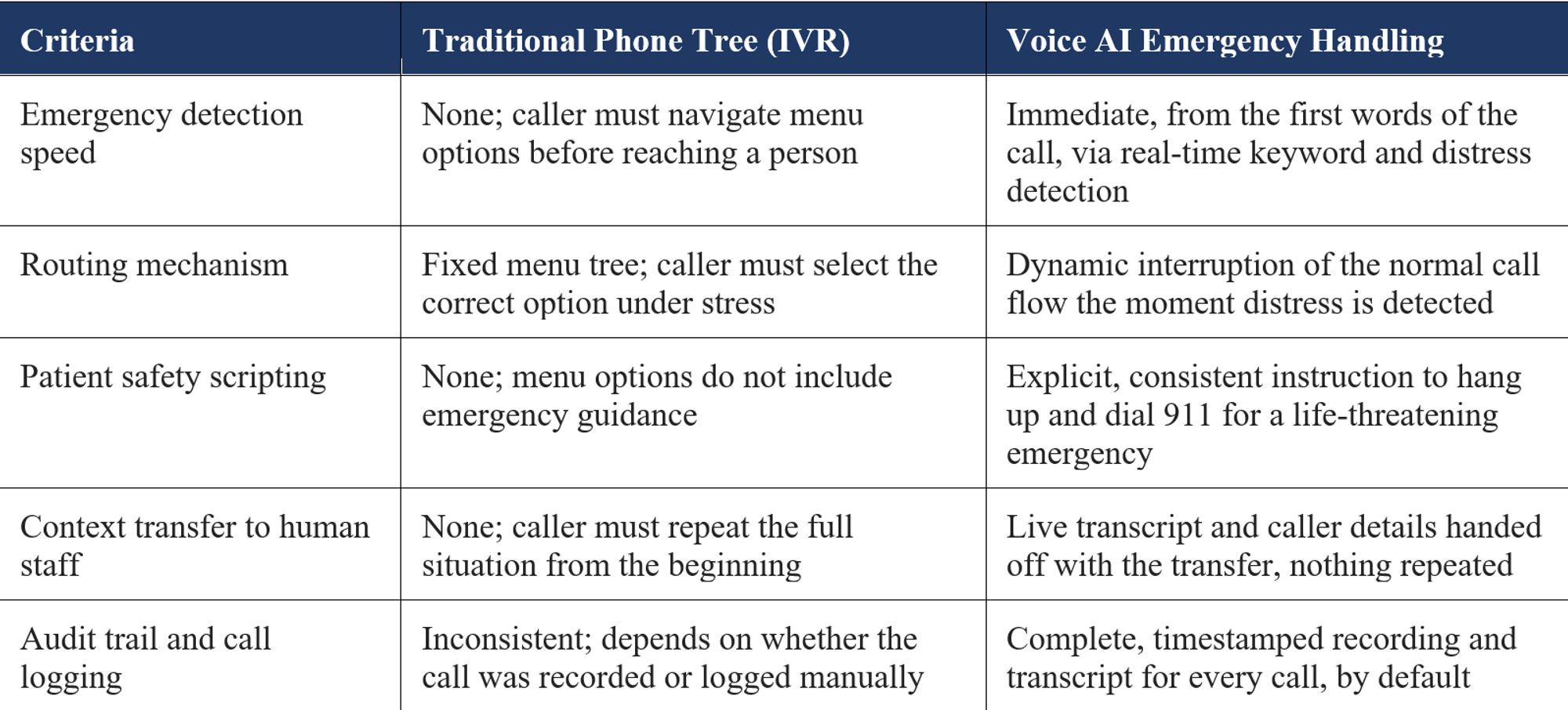
The gap between these two columns is not a matter of degree. A traditional IVR has no emergency detection capability at all; it routes every caller identically regardless of what they are saying. A voice AI built for this use case treats emergency detection as a parallel process running on every call, not a menu option a caller has to find.
Liability, HIPAA Compliance, and Operational Audit Trails
Every emergency-adjacent call handled by a voice AI receptionist generates a complete, timestamped audio recording and real-time transcript. For an NEMT provider, this is direct protective documentation: if a call handoff is ever questioned after the fact, the provider has an exact, unaltered record of when distress language was detected, what scripting was delivered to the caller, and how quickly the call was escalated to a human, rather than a dispatcher's after-the-fact recollection of what happened.
This same recording and transcription infrastructure has to be handled correctly under HIPAA, since a caller's medical condition, name, and location during a health-related call constitute protected health information. A voice AI vendor should have a signed Business Associate Agreement (BAA) in place with the provider, and access to raw recordings and transcripts should be limited and logged. A system that produces a strong audit trail but stores or transmits that data insecurely has solved one problem while creating another, so both need to be evaluated together, not treated as separate checkboxes.
It is also worth being precise about what this technology is not. A voice AI receptionist does not replace 911, does not perform clinical triage, and is not a substitute for emergency medical judgement. Its role is narrow and specific: detect distress fast, deliver consistent safety instructions, and get a human involved immediately. Providers evaluating a vendor should ask directly how the system is tested for false negatives (missed emergencies) and false positives (unnecessary escalations), since neither failure mode is acceptable at scale.
Frequently Asked Questions
Can an AI receptionist dial 911 directly on behalf of a caller?
No. The AI instructs the caller to hang up and dial 911 themselves for a life-threatening emergency, since the caller's own device and location data are what 911 dispatch systems are built to use. The AI's role is to deliver that instruction immediately and clearly, then escalate to a human on the NEMT side.
What medical keywords trigger an immediate emergency escalation in voice AI?
Common triggers include language describing chest pain, difficulty breathing, active bleeding, loss of consciousness, stroke symptoms, and general distress or panic, alongside acoustic signals like laboured speech or a caller shouting for help. The exact keyword and pattern set should be tuned and tested regularly, not treated as a fixed list.
What happens if a caller is confused, disoriented, or unable to speak clearly?
Confused or disoriented speech is itself a distress signal that a well-built voice AI is trained to recognise, not just explicit emergency keywords. When a caller's ability to communicate clearly is degraded, that pattern alone should trigger faster escalation to a human rather than the AI attempting to continue a normal conversation.
How quickly does the voice AI hand off an emergency call to a human dispatcher?
Detection and workflow interruption happen within the first moments of the call, and the warm transfer to a human, with transcript and caller data attached, follows immediately after the safety script is delivered. There is no hold queue or menu navigation between detection and handoff.
How does NEMTalk assist NEMT providers in managing emergency call risks safely?
NEMTalk is purpose-built voice AI for NEMT call patterns, with real-time emergency keyword and distress detection running on every call by default. It delivers zero-hold-time handoffs to live dispatchers the moment distress is detected, and produces complete, timestamped call logging for every interaction, giving providers a documented compliance and safety record without building that infrastructure themselves.
Who This Guide Is Specifically For
This guide is for NEMT business owners looking to eliminate liability and call center blind spots that a manual or IVR-based phone system leaves open. It is for operations managers who need dependable 24/7 safety guardrails without staffing a dedicated overnight team to cover them. It is for healthcare facility coordinators evaluating the patient safety standards of a transportation partner before signing or renewing a contract. If emergency call handling is currently undocumented or inconsistent in your operation, this protocol is the standard to evaluate against.