Friday, August 21, 2026
Can an AI Receptionist Answer Patient Questions 24/7 in NEMT? Full Operational Breakdown

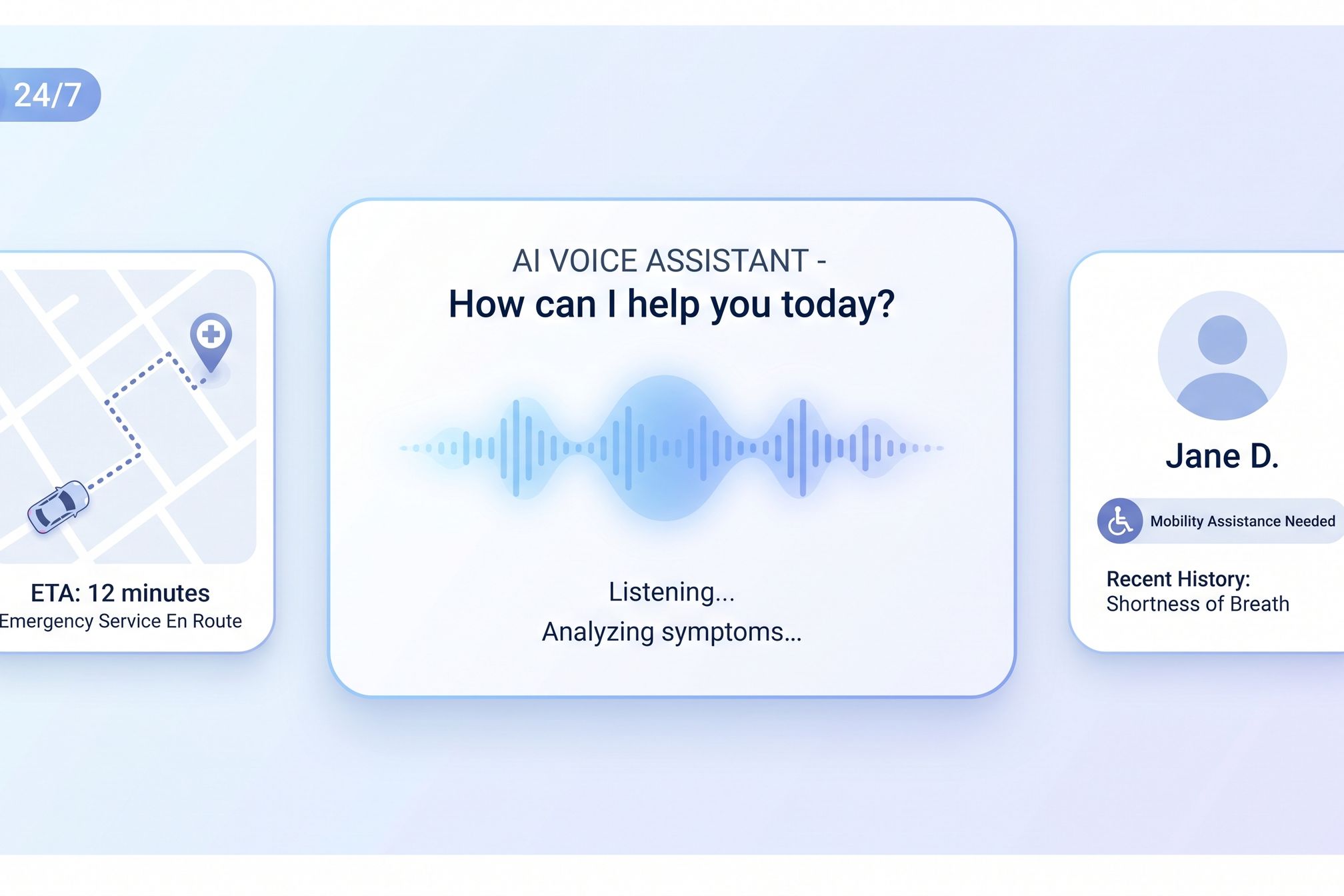
Yes, a properly built AI receptionist can answer NEMT patient questions 24/7. It picks up on the first ring, verifies standing orders, books and modifies trips, pulls live GPS data to answer “where's my ride?” requests, and instantly escalates any true medical emergency to a human dispatcher with full call context attached.
The 24/7 Patient Communication Problem in NEMT
NEMT call volume does not follow business hours, even when dispatch staffing does. Late-night appointment changes come in after a family member gets home and realises tomorrow's pickup time conflicts with a new commitment. Early-morning ride confirmations pile up during the 6:00 AM rush, as riders and facility staff confirm same-day trips before the first pickups roll out. Weekend dispatch gaps leave Saturday and Sunday callers with no live person to reach at all, since most NEMT operations do not staff a full weekend call desk.
Each of these gaps carries a direct financial cost. A missed after-hours call is a missed trip booking, and a rider who cannot reach anyone to confirm a ride often cancels rather than risk missing an appointment. Providers who patch this gap with a third-party after-hours answering service pay ongoing fees for a service that still cannot access live dispatch data, book a trip directly, or verify a standing order, meaning the caller often has to call back again once the office reopens. Providers who patch it with on-call dispatcher rotations pay overtime and accelerate the exact burnout that drives dispatcher turnover, since after-hours and weekend coverage is the shift nobody wants long-term.
What Patient Inquiries Can a 24/7 Voice AI Actually Handle?
Real-Time “Where's My Ride?” (WQMR) and Live ETA Lookups: The AI queries dispatch GPS integration directly and gives the caller an accurate, current ETA without routing the request to a human.
Ride Bookings, Modifications, and Cancellations: Requests are updated directly to the dispatch manifest in real time, with no manual re-entry once the call ends.
Voice-Activated Will-Call Pickups: A patient leaving a clinic or finishing a dialysis session can activate their return pickup by voice the moment they are ready, instead of waiting on hold.
Capturing Mobility and Special Needs: Wheelchair, stretcher, oxygen, and door-to-door requirements are logged accurately on the trip record without a dispatcher having to ask a second time.
Facility Coordination: Clinic and facility staff calling to check on multiple patient pickups at once get status on each one in a single call, rather than one call per patient.
Conversational Voice AI vs. Traditional Phone Menus (IVR)
A traditional IVR forces every caller down a rigid “press 1 for dispatch, press 2 for status” tree, which works reasonably well for a caller who already knows exactly what they need and can navigate a menu quickly. It works poorly for the population NEMT actually serves. Elderly riders, patients with mobility or cognitive limitations, and family members calling under stress often just want to say what they need in plain language and be understood immediately.
Modern conversational voice AI, built on natural language processing (NLP), removes the menu entirely. It understands non-linear speech, regional accents, and information delivered out of order, the same way a well-trained human dispatcher would. A caller who says “my mom's ride never showed up and she's still at the clinic” is understood as a WQMR and escalation request immediately, without needing to know which menu option that falls under.
Safety, HIPAA Compliance, and Human Escalation Protocol
A 24/7 AI receptionist is not designed to replace clinical judgement, and a properly built system is explicit about that boundary. The AI is trained to recognise language and vocal patterns associated with true medical emergencies, chest pain, breathing difficulty, a fall, loss of consciousness, or general distress, and to immediately transfer the caller to an on-call human dispatcher rather than attempting to resolve the situation itself.
Escalation includes full transcript context, so the human dispatcher receiving the transfer already has the caller's identity, trip details, and the substance of what has been said so far. This avoids the common IVR failure mode where a distressed caller has to repeat themselves from the beginning once they finally reach a person. On the compliance side, any system handling patient trip data and call transcripts needs a signed Business Associate Agreement (BAA) in place, since that data constitutes protected health information under HIPAA.
Operational ROI and Impact Breakdown
The operational case for 24/7 voice AI in NEMT rests on a small number of measurable shifts, not a vague promise of “better service.”
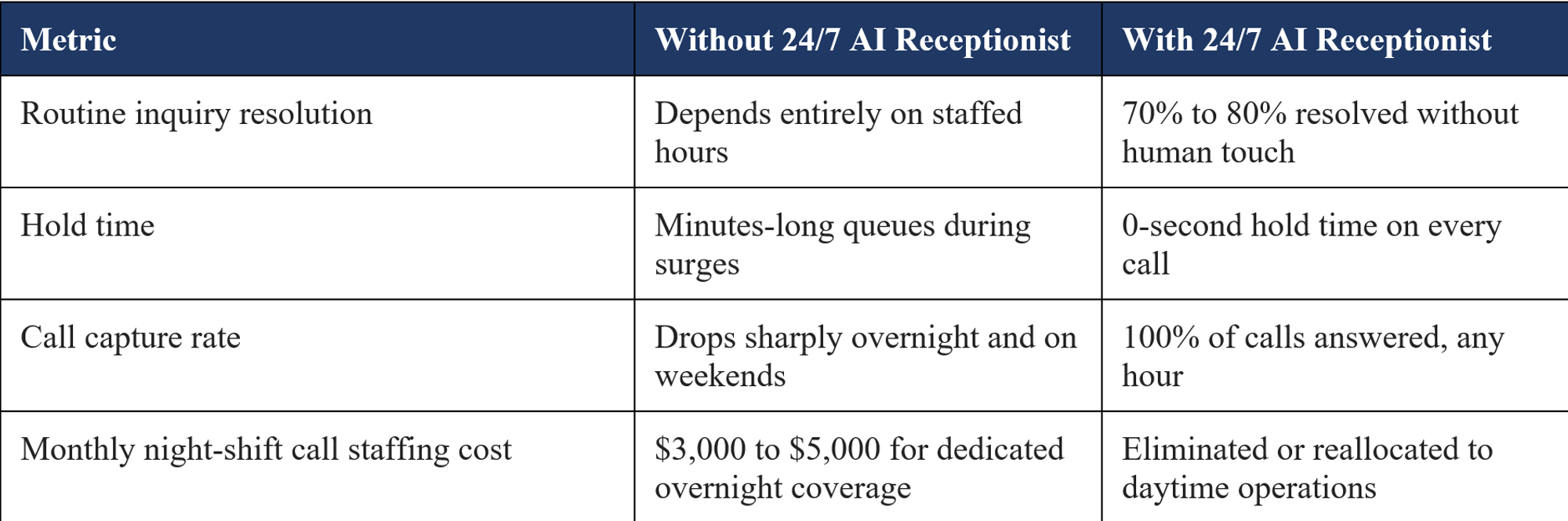
Resolving 70% to 80% of routine inquiries without a human touch does not mean dispatchers become unnecessary. It means the calls that do reach a human are disproportionately the ones that actually need a human, complex modifications, facility negotiations, and true escalations, rather than a WQMR request that a voice AI could have answered instantly at 2 AM.
Frequently Asked Questions
How does an AI receptionist handle elderly patients or callers with strong accents?
A well-built AI receptionist uses natural language processing trained on conversational, non-linear speech, allowing it to understand elderly callers and strong or regional accents without forcing them through a menu. When confidence in understanding a request is low, the call is routed to a human rather than acted on incorrectly.
Can an AI receptionist access live GPS data to tell a patient where their driver is?
Yes. A properly integrated AI receptionist queries live dispatch GPS data directly and reports an accurate, current ETA to the caller in real time, the same information a human dispatcher would be checking manually.
What happens if a patient calls with a life-threatening medical emergency?
The AI is trained to recognise emergency language and distress signals and immediately transfers the call to a human dispatcher, with full transcript context attached. It is built to handle non-emergency scheduling and status calls, not to manage a medical emergency independently.
Is an AI receptionist active on weekends, holidays, and overnight shifts?
Yes, that is the core use case. A 24/7 AI receptionist answers calls at the same speed and accuracy at 3 AM on a Sunday as it does at 8 AM on a Tuesday, closing the exact coverage gaps that weekend and overnight staffing normally leaves open.
How can NEMTalk assist NEMT providers in deploying a 24/7 AI receptionist?
NEMTalk is a voice AI built specifically for NEMT call patterns, not a generic answering service adapted after the fact. It integrates directly with existing dispatch systems to handle live ETA lookups, will-call voice activation, and routine booking changes, delivering zero-hold-time call handling around the clock without requiring providers to replace the scheduling software they already run.
Who This Guide Is Specifically For
This guide is for NEMT business owners looking to eliminate missed calls that quietly cost them trip revenue every week. It is for dispatch directors seeking to automate after-hours support without hiring a dedicated overnight team or paying an answering service that cannot actually book a trip. It is for medical transit operators trying to scale trip volume and facility contracts without a proportional increase in call-center payroll. If any of those describe your operation, the case for 24/7 voice AI is an operational one, not a novelty one.