Wednesday, August 19, 2026
AI in NEMT Dispatching: How AI Receptionists and Smart Routing Transform Fleets

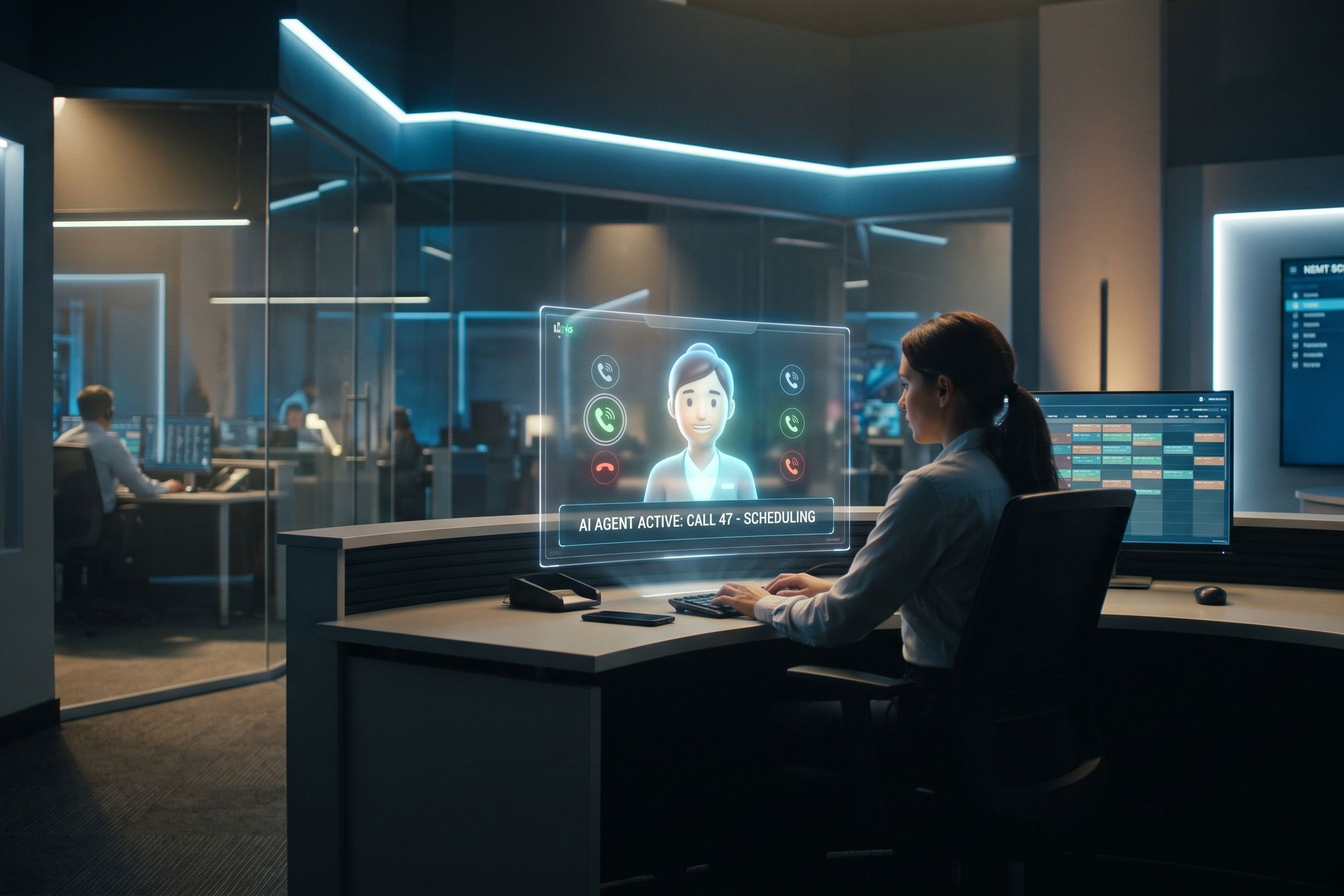
The pressure driving this shift is structural, not seasonal. Trip volume in NEMT rises with an ageing population and expanding Medicaid and Medicare Advantage transportation benefits, but dispatch teams cannot scale headcount at the same pace without labor costs eating into already thin trip margins. AI dispatching exists specifically to close that gap, absorbing call and scheduling volume growth without a proportional increase in staffing.
What is AI NEMT Dispatching and How Does an AI Receptionist Work?
AI NEMT dispatching combines a conversational voice AI receptionist with dynamic scheduling algorithms to automate the full trip lifecycle. The AI receptionist answers calls, captures trip details through natural language, and books, modifies, or tracks rides instantly, while the scheduling engine assigns trips to the best-matched vehicle and driver and continuously optimizes routes using live traffic and GPS data.
The 24/7 Front Office: AI Receptionist Capabilities
An AI receptionist handles 24/7 NEMT call intake automation, which changes the shape of a dispatch office's day more than it changes any single call.
Zero Hold Times: Handles the 6:00 AM to 9:00 AM morning peak call surge and after-hours bookings without adding staff, since every caller is answered on the first ring regardless of volume.
Automated “Where's My Ride?” (WQMR) Tracking: Queries live GPS feeds in real time to give callers an accurate passenger ETA instantly, without routing the request through a human dispatcher.
Will-Call and Return Activations: Voice-activates return trip dispatching the moment a rider finishes their appointment, removing the hold-time step between “I'm ready” and a driver being assigned.
Acuity and Special Needs Capture: Logs mobility requirements, wheelchair, stretcher, bariatric, or oxygen needs, accurately and automatically on the trip record, so the right vehicle is assigned the first time.
Intelligent Backend Dispatching and Smart Routing
Voice AI for healthcare transport solves the front-office call volume problem. Automated medical route optimization solves the backend scheduling problem, and the two are most effective when they operate on the same trip data rather than as separate systems.
Dynamic Route Optimization: Continuously recalculates routing to reduce deadhead miles by 10% to 15% and boost vehicle utilization by 30% to 40%, compared to static, manually-planned routes.
Smart Driver-to-Trip Matching: Auto-assigns trips based on vehicle capability, driver certifications (CPR, PASS), and live traffic conditions, rather than a dispatcher manually cross-checking each constraint.
Together, these capabilities are what separate a genuine AI NEMT dispatching system from a basic auto-scheduler: the routing engine adjusts continuously as new trips, cancellations, and traffic conditions come in, instead of running a fixed plan built once at the start of the day. A static morning schedule is already stale by 9 AM once same-day discharges, cancellations, and traffic incidents start arriving, and a dispatcher manually re-threading a dozen affected trips cannot keep pace with a routing engine recalculating in the background continuously.
The compounding effect matters more than any single optimization. Reduced deadhead miles lower fuel and vehicle wear costs directly. Higher vehicle utilization means the same fleet completes more billable trips per shift without adding a vehicle. Accurate driver-to-trip matching means a wheelchair van is never assigned a walk-in ambulatory trip while a wheelchair-dependent rider waits for the next available vehicle, an error that costs both trip revenue and patient trust when it happens repeatedly.
Manual Dispatching vs. AI-Powered NEMT Dispatching
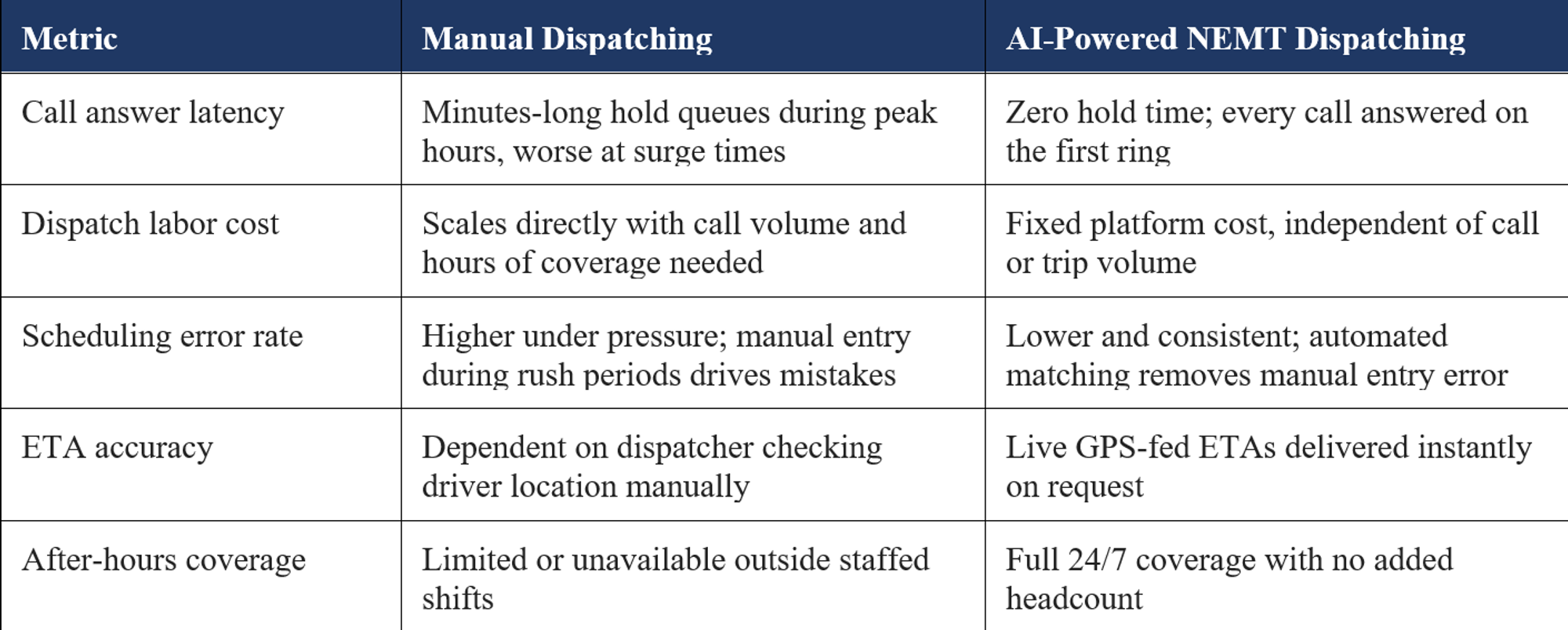
AI dispatching does not just reduce cost per call. It removes the ceiling on how much call and trip volume an operation can absorb without adding headcount.
Real-World Case Scenario: A 12-Vehicle Fleet
Consider a 12-vehicle NEMT fleet running two full-time phone dispatchers to cover call intake, scheduling, and WQMR requests across a standard business day. Before adopting AI dispatching, the fleet's missed call rate ran at 18%, driven by peak-hour surges and after-hours calls going to voicemail. Each missed call represented either a lost booking or a rider left without a status update.
After replacing the two full-time phone dispatchers with an AI receptionist integrated into the fleet's dispatch and routing system, the missed call rate dropped from 18% to under 1%. Every call, regardless of time of day or volume, is now answered and processed. The fleet's annual administrative overhead fell by approximately $65,000, driven by the elimination of two dispatcher salaries and the reduction in missed-trip rebooking and rider complaint handling that previously consumed additional staff time.
The AI dispatch software ROI in this scenario is not solely the labor cost saved. It includes the trip revenue previously lost to unanswered calls, now captured, and the reduction in facility dissatisfaction that comes from consistent, immediate call handling at every hour the fleet operates.
The labor saving is also not a one-time reduction. As this fleet adds vehicles or takes on a new facility contract, call and scheduling volume grows without requiring a third or fourth dispatcher to be hired. That is the structural difference between a cost reduction and a scalability improvement: the first saves money once, the second changes how the business can grow without its overhead growing at the same rate.
Frequently Asked Questions
How does an AI receptionist handle elderly patients or complex accents?
A properly built AI receptionist uses natural language processing trained on conversational, non-linear speech, which allows it to understand elderly callers, strong accents, and information provided out of order, rather than requiring callers to navigate a rigid menu tree. When confidence is low, the call is routed to a human dispatcher rather than guessed at.
Can AI dispatching handle last-minute cancellations and same-day hospital discharges?
Yes. The scheduling engine re-optimizes routes in real time as cancellations, additions, or same-day discharge requests come in, reassigning trips to the best-available vehicle and driver without requiring a dispatcher to manually rebuild the schedule.
What happens when an emergency medical situation occurs during a call?
AI receptionists are built to recognize emergency language and distress signals and immediately escalate the call to a human dispatcher or the appropriate emergency protocol. The AI handles non-emergency scheduling and status calls; it is not designed to manage a medical emergency independently.
Does adopting AI dispatching require replacing our entire existing fleet system?
Not necessarily. Most AI dispatching and AI receptionist platforms are built to integrate with existing dispatch and scheduling software rather than requiring a full system replacement, though the depth of integration varies by provider and should be confirmed before adoption. Providers evaluating a switch should ask specifically how call, trip, and GPS data flow between the AI layer and whatever system currently handles billing and manifests, since a shallow integration can recreate the same reconciliation burden the AI system was meant to remove.
How can NEMTalk assist providers looking to adopt AI dispatching and AI receptionist technology?
NEMTalk provides the 24/7 AI receptionist layer purpose-built for NEMT call volume, handling call intake, WQMR status requests, will-call activation, and acuity capture without adding dispatch staff. It runs as an independent system, so it integrates directly into the dispatch, routing, and billing tools a provider already uses, giving fleets the front-office automation of an AI receptionist without requiring a full replacement of their existing scheduling software.
Who this Blog Post For?
This guide is written for NEMT fleet owners overwhelmed by call volume and dispatch labor costs, operations managers scaling their scheduling process from manual coordination to automated systems, and healthcare transportation providers evaluating voice AI solutions for the first time.